State media reports that the Hanoi–Hai Phong Expressway—a multi-trillion-dong transportation project with a road surface meeting international standards—is facing an ironic reality: the road is wide open, yet traffic is sparse.
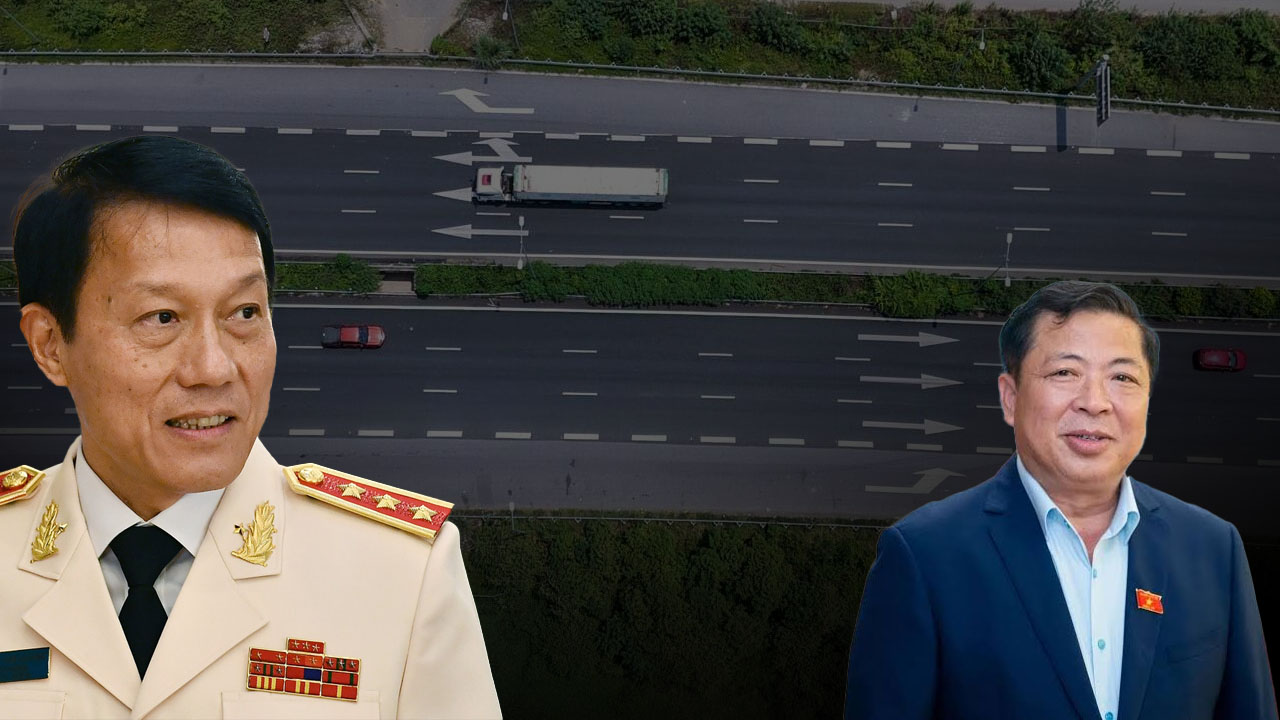
Meanwhile, not far away, the dilapidated lanes of National Highway 5 remain perpetually gridlocked, with a line of container trucks and heavy-duty trucks inching forward meter by meter.
According to observers, this stark contrast is not merely a story of failed traffic diversion but also a conflict between the goal of economic development and a top-down management mindset from law enforcement agencies.
When the government decided to pour massive investment resources into building a modern expressway network, the goal was to create high-speed transportation arteries, reduce logistics costs, and optimize the economy’s competitive edge.
However, this strategic objective is being undermined by the practical barriers that all transportation companies and drivers face on a daily basis.
In addition to the financial burden of excessively high BOT tolls, there is a decisive factor driving drivers’ reluctance to use expressways: the suffocating pressure from the policy of issuing automated fines for failing to maintain a safe following distance.
The regulation on minimum safe following distances on expressways is, in theory, a sound policy aimed at protecting lives and property.
However, the rigid implementation of the police’s automated surveillance camera system has turned a safety regulation into a psychological “trap” for drivers.
As a result, the camera system typically captures only a static moment at a given time, completely ignoring the dynamic flow of traffic. But in reality, it is a daily occurrence for a passenger car to suddenly cut in front of a container truck, invading the safety zone in front of it.
In such situations, truck drivers—whether they want to or not—are forced into a violation with no way to protect themselves from the automated enforcement cameras. Furthermore, applying a uniform safe distance requirement across the entire route without accounting for specific terrain factors—such as uphill sections or large overpasses—is highly unreasonable.
Requiring drivers to maintain an absolute distance as if on flat ground not only eliminates the vehicle’s momentum, leading to fuel waste, but also defies the laws of physics.
This lack of thorough consideration by the Ministry of Public Security has led to an inevitable consequence: to avoid the risk of fines running into the millions and losing their livelihoods, many drivers opt to take regular national highways instead.
They accept crawling through the traffic jams on National Highway 5—which is dangerous—rather than facing legal risks on modern, internationally standardized expressways.
The public has every right to question the actual effectiveness of these “off-site” enforcement campaigns by the traffic police in ensuring drivers maintain proper following distances.
Is the Ministry of Public Security placing too much emphasis on maximizing fine revenue while neglecting its core objective—which is to free up traffic capacity for the economy?
According to experts, a sound management policy must never produce the opposite effect by forcing vehicles off modern highways onto outdated and overloaded national highways.
To return container trucks to their proper place on the highways, the Ministry of Public Security’s management approach must shift from control and punishment to regulation and support aimed at promoting development.
At the same time, the economic issue of toll fees needs to be recalculated through a mechanism that significantly reduces fees during late-night off-peak hours.Only when these psychological and cost-related bottlenecks are removed can the hundreds-of-millions-of-USD highway infrastructure serve as a lever for the economy.Trà My – Thoibao.de =======Deserted Trillion-Dong Expressways and the Paradox in the Ministry of Public Security’s Management Approach ?“… The absence of vehicles on the expressways exposes shortcomings in planning and a paradox in the Ministry of Public Security’s management approach, resulting in a massive waste of national infrastructure resources.”#Vietnam #ChinhTruongVN #Thoibao